
How Will This Help?
- Many programs may increase safety and decrease auto emissions by using any strategies that reduce the number of vehicle miles traveled or shift travel to less dangerous times than the peak period.
State Employee Trip Reduction Best Practices
Type of Location: Regions with concentrated levels of state or other government employees.
Agency Practices: Train supervisors and managers
Frequency of Reanalysis: Annually
Supporting Policies or Actions Needed: Allow agencies to set and measure their own goals
Complementary Strategies: Emergency ride home programs, an on-line matching program to enable people to find other state employees with similar commutes, incentive programs, carpooling, vanpooling, transit, flextime, telecommuting, and compressed work weeks.
Target Market
Locations with a Concentration of State Workers
As of 2010, the State of Texas employs over 260,000 employees statewide, full-time and part-time, in varied agencies and capacities. Large agencies can have a significant impact to the transportation system when they are clustered together, but this is also where trip reduction strategies can have the most noticeable effects.
Agencies with a Direct Interest in Reducing Traffic Congestion
Some of the agencies most motivated to apply trip reduction strategies are those with a direct interest in reducing traffic congestion and air pollution, for example, transportation, environment, energy, and facilities management.
Agencies Interested In These Strategies as Part of an Employee Satisfaction/Retention Initiative
Other agencies might be motivated to participate because their leadership is interested in workplace flexibility as part of a larger employee satisfaction/retention initiative. Indeed, a 2010 report by the Texas Comptroller of Public Accounts, Analysis of Alternative Work Schedules, considered alternatives to the standard five-day, 40-hour workweek for state employees.
Implementation Examples
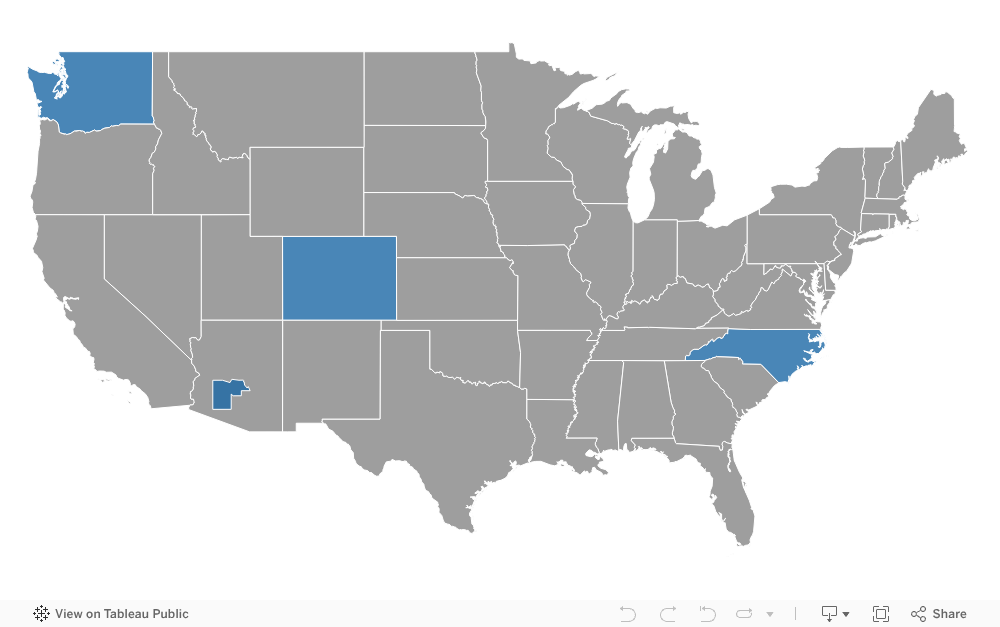
Texas possesses its own unique circumstances which will influence the success of any initiative to reduce state employee commute travel. The size of the state and the varieties of issues confronting different localities are two dimensions illustrating this point. Nonetheless, other states offer examples which can provide insight into which strategies might work best for Texas state agencies.
Agency-Specific Initiatives

The State Attorney General’s Office implemented a program to incentivize its employees to reduce single occupancy auto vehicle travel. Options include a subsidized EcoPass for transit, bike lockers, a guaranteed ride home, ride sharing matching, as well as allowing flexible schedules and telework on a limited basis.
Formalized Trip Reduction Programs
Application Techniques and Principles
As discussed above, some of the most important issues concern not the strategies chosen but their implementation and support by state leadership—both agency leaders and decision-makers. Public perception that customer service is not being affected is critical, as demonstrated in the 2010 Texas State Comptroller report. Measurement of program benefits—in terms of trips avoided, fuel saved, and improved employee productivity—is a key strategy for program success.
Measuring Trip Reduction and Other Benefits
Not all Texas agencies monitor their alternative work schedule (AWS) employees. Among those that do, 32 percent of employees reduced their commute time and 20 percent reduced their fuel expenses (Texas Comptroller, 2010). Expanding upon this type of measurement will be critical if Texas moves forward into using state employee trip reduction programs, because these measures provide decision makers and the public information on the return on investment made in these programs.
Measuring Employee Performance
Monitoring performance is an issue of concern to both employers and employees. Performance monitoring tools vary according to the travel option, but examples include:
- Setting measurable performance goals and deadlines.
- Video-check in and communication tools.
- Using technological tools to monitor employee productivity, including computer activity, keystrokes, and website usage.
- Off-worksite supervisor visits.
The 2010 Texas Comptroller report on AWS noted that 23 percent of Texas agencies indicate supervision of employees as one challenge of AWS; however, just under half of Texas agencies do not provide AWS training for managers or supervisors. This type of training will be critical to successful implementation of any AWS component of a trip reduction program.
Issues
Trip reduction strategies require consistent and equitable follow-through. Any perceived or real benefit to participation by state employees needs to be monitored to be considered fair. Agency leadership may perceive their resources are already spread thin, and any new initiative requires a time investment to make it work.
Cost
A trip reduction program does involve upfront costs, as the examples from elsewhere in the nation demonstrate. For AWS alone, the 2010 Texas Comptroller report on AWS found that cost savings were minimal. Nonetheless, the Texas Comptroller found that the retention benefits for Texas worker participating in existing AWS were demonstrable.
Data Needs
Successful programs such as Washington state’s requires quantifiable goal setting and performance monitoring. Online surveys can be used to aggregate statistics by departments to monitor progress toward goals. Teleworking programs are sometimes tracked through time billing: unique codes are entered for time spent at home, which does not require any additional data to report.
Who Is Responsible?
Although many Texas agencies have AWS policies in place as an employee benefit, and certain supervisors and managers may facilitate this activity, the examples above demonstrate that the most effective employee trip reduction programs nationwide are those that are required, either by state statute or to comply with a federal environmental requirement.
Many states have a single state agency that sets policies for state workers. In Texas, policies affecting state workers are set by statute and implemented by individual agencies. This may actually be an advantage if trip reduction targets are set, but Texas agencies are allowed the flexibility in how to best meet those goals.
Project Timeframe
Many Texas agencies already have the policies in place, but participation may not be actively encouraged agency-wide. With the policies already in place, a ramp-up implementation may be fairly short-term: a matter of educating agency leadership that AWS is a priority strategy for addressing congestion and has other measurable benefits.
A longer-term strategy with the potential for greater success, based upon examples from other states, is a statutorily mandated program following the Public Agency Trip Reduction Best Practices listed below.
For More Information
1. 2011 CTR Report to the Washington State Legislature, Washington State Commute Trip Reduction Board, at: http://www.wsdot.wa.gov/Transit/CTR/, accessed on June 14, 2012.
2. Analysis of Alternative Work Schedules, Texas Comptroller of Public Accounts, August 2010. Also located at: http://www.window.state.tx.us/specialrpt/altschedule/Alternative_Wrk_Sched.pdf.
3. Hill, E. G. 2002, “A Commuter’s Dilemma: Extra Cash or Free Parking?” California Legislative Analyst’s Office. http://www.lao.ca.gov/laoapp/main.aspx
4. Rodríguez D A, 2002, “Examining Individuals’ Desire for Shorter Commute: The Case of Proximate Commuting” Environment and Planning B: Planning and Design 29(6) 867 – 881.
5. Maricopa County Air Quality Department. Trip Reduction Program. http://maricopa.gov/aq/divisions/trip_reduction/Default.aspx. Accessed Oct. 13, 2014.